

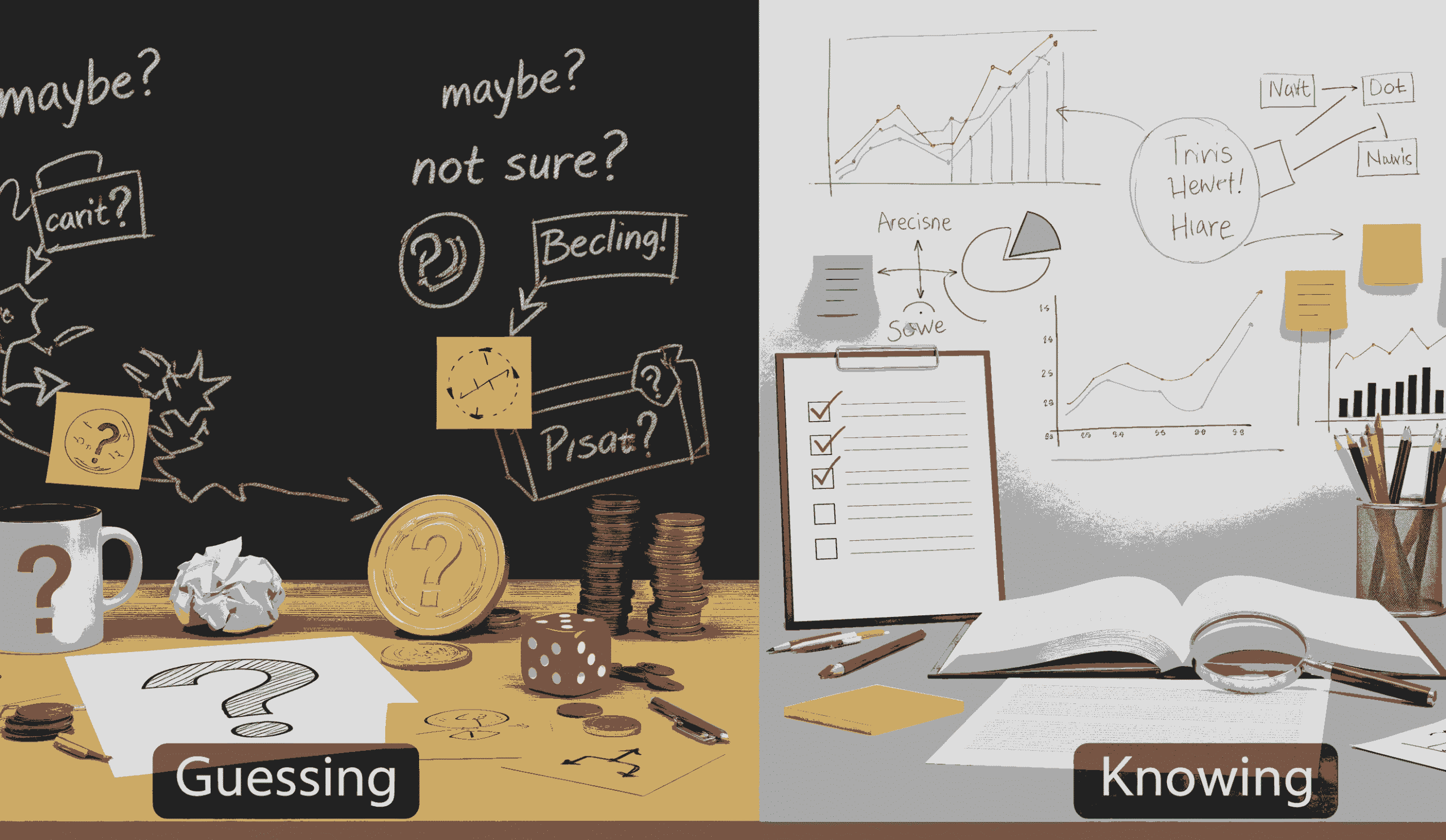
Wonder no more what the actual opposite of “guess” is. Whether you’re a student, writer, foreign language learner, or simply looking to brush up on your grammar skills, knowing the opposite of guess is equivalent can help you expand your knowledge of the language and avoid using the word guess incorrectly. Today, I’m going to explain everything you need to know about the antonym of “guess,” clearing up some common confusions and providing you with practical advice for using this knowledge with confidence.
Let’s dive in!
What Does “Guess” Mean?
Before we find its opposite, though, let’s clarify what “guess” really is.
2.Guess(verb):To come to some conclusion without having enough information or evidence.
Example: It looks like it’s going to rain today.
Guess (n.): An opinion as to anything, formed without sufficient or decisive evidence; — opposed to knowledge.
Example: That was totally a wild guess.
Guesswork isn’t usually the cold certainty of fact, it’s uncertainty; grasping at straws if you will with some assumptions and a little intuition thrown in.
The Opposite of “Guess”: What Could It Be?
Now, moving on to the big question: what is the opposite of “guess”? Here, it’s essential to consider context because words like “know,” “determine,” or “confirm” could serve as antonyms in different situations.
Key Antonyms for “Guess”
| Term | Definition | Usage Example |
|---|---|---|
| Know | To have definite information about something. | I know the answer; I don’t need to guess. |
| Determine | To ascertain exactly or typically after investigation or calculation. | We will determine the results after the experiment. |
| Ascertain | To find out or confirm definitively. | She tried to ascertain the truth of the statement. |
| Confirm | To establish the truth or correctness of something with certainty. | The test results confirmed his diagnosis. |
| Verify | To check or test the validity or accuracy of something. | I need to verify the facts before publishing. |
| Identify | To recognize or establish the identity of something or someone accurately. | Can you identify the person in this photo? |
Clarifying the Best Opposite: Know or Confirm?
While “know” is a common antonym, technically, “confirm” or “verify” are more precise when you’re talking about establishing certainty, especially in formal or factual scenarios.
Quick Summary:
- Guess implies uncertainty and assumption.
- Know, confirm, and verify imply certainty and factual accuracy.
Why Is Knowing the Opposite Important?
It’s not just academic, knowing the opposite of guess. It helps you:
Communicate more precisely.
Avoid ambiguity.
Express certainty in your statements.
Make stronger, more confident decisions.
A word is the right word if it makes a vague doubt seem less vague. For example:
“I guess this is correct.” (Uncertain)
“I know this is correct.” (Certain)
Practical Tips for Using the Opposite of “Guess”
- Use “know” when you have facts: When you’re confident about information.
- Use “determine” or “ascertain” for facts: When verifying through investigation.
- Use “confirm” when validating: Especially after tests or evidence.
Tips for Success in Using Opposites of “Guess”
- Always consider context: The right antonym depends on whether you want to express certainty, investigation, or confirmation.
- Avoid overusing “know”: Sometimes “know” might sound too absolute. Use “verify” or “confirm” in technical or precision contexts.
- Practice with sentences: Replace “guess” with its antonyms to get comfortable with their nuances.
Common Mistakes and How to Avoid Them
| Mistake | Correct Approach | Explanation |
|---|---|---|
| Using “know” when certainty isn’t achieved | Use “guess” or “suppose” when uncertain | Be precise about your level of confidence. |
| Confusing “determine” with “guess” | Use “determine” when you have data or proof | “Determine” implies process, not assumption. |
| Saying “I guess this is true” when you are sure | Switch to “I know this is true” | Avoid ambiguity, especially in formal writing. |
Similar Variations to Explore
- Estimated vs. Confirmed: One is an approximation, the other is verified.
- Suppose vs. Prove: “Suppose” involves assumptions; “prove” confirms facts.
- Assume vs. Authenticate: One guesses, the other validates authenticity.
Why Is It Important to Use Correct Antonyms?
Using precise words like “know,” “confirm,” or “verify” instead of “guess” elevates your language and improves clarity. Whether in academic writing, professional communication, or everyday conversations, the difference can change how your message is received.
Practice Exercises
Let’s make sure you get comfortable with these words.
1. Fill-in-the-blank
a) I don’t just _; I _ the answer after reviewing the data.
b) Can you _ the details of the event?
c) She _ that he will arrive on time.
Answers:
a) guess, know
b) verify / confirm
c) assumes (or guesses—context-dependent)
2. Error Correction
Original:
“I guess the train leaves at 9 am.”
Corrected:
“I know the train leaves at 9 am.”
Tip: Replace “guess” if you have confirmed the schedule.
3. Identification
Under which circumstances would you use each word?
a) You’re unsure about a fact.
b) You’ve checked official records.
c) You’re making an educated estimation.
Answers:
a) guess / suppose.
b) verify / confirm.
c) estimate / approximate.
4. Sentence Construction
Create sentences using the opposite of “guess” — at least one with “know” and another with “verify.”
Sample:
- I know the meeting is scheduled for Monday.
- I will verify the appointment details before confirming.
5. Category Matching
Match the words with their appropriate context:
| Word | Context |
|---|---|
| Guess | Making a decision without enough info |
| Confirm | Validating or establishing certainty |
| Know | Having factual information |
| Determine | Finding out through analysis or investigation |
Final Thoughts: Mastering the Opposite of Guess
In short, the opposite of “guess” isn’t merely a word to take its place. It’s about catching the nuance between uncertainty and certainty. Using precise terms such as “know,” “verify” or “confirm’ deepens you conversations and makes them more authoritative.
Remember: Every time you are sure of your answer, trade out “guess” for a word that shows that confidence. It’s a small adjustment that can make a huge difference in how your message lands.
So next time you are in doubt — use “guess.” But when you’re positive — be positive with “know” or “confirm.” This simple switch elevates your clarity and professionalism.
Happy practicing! Now go out and confidently replace “guess” with its perfect opposite in your writing and speech.

1 Comment
I have recently started a site, the information you offer on this website has helped me greatly. Thanks for all of your time & work.