

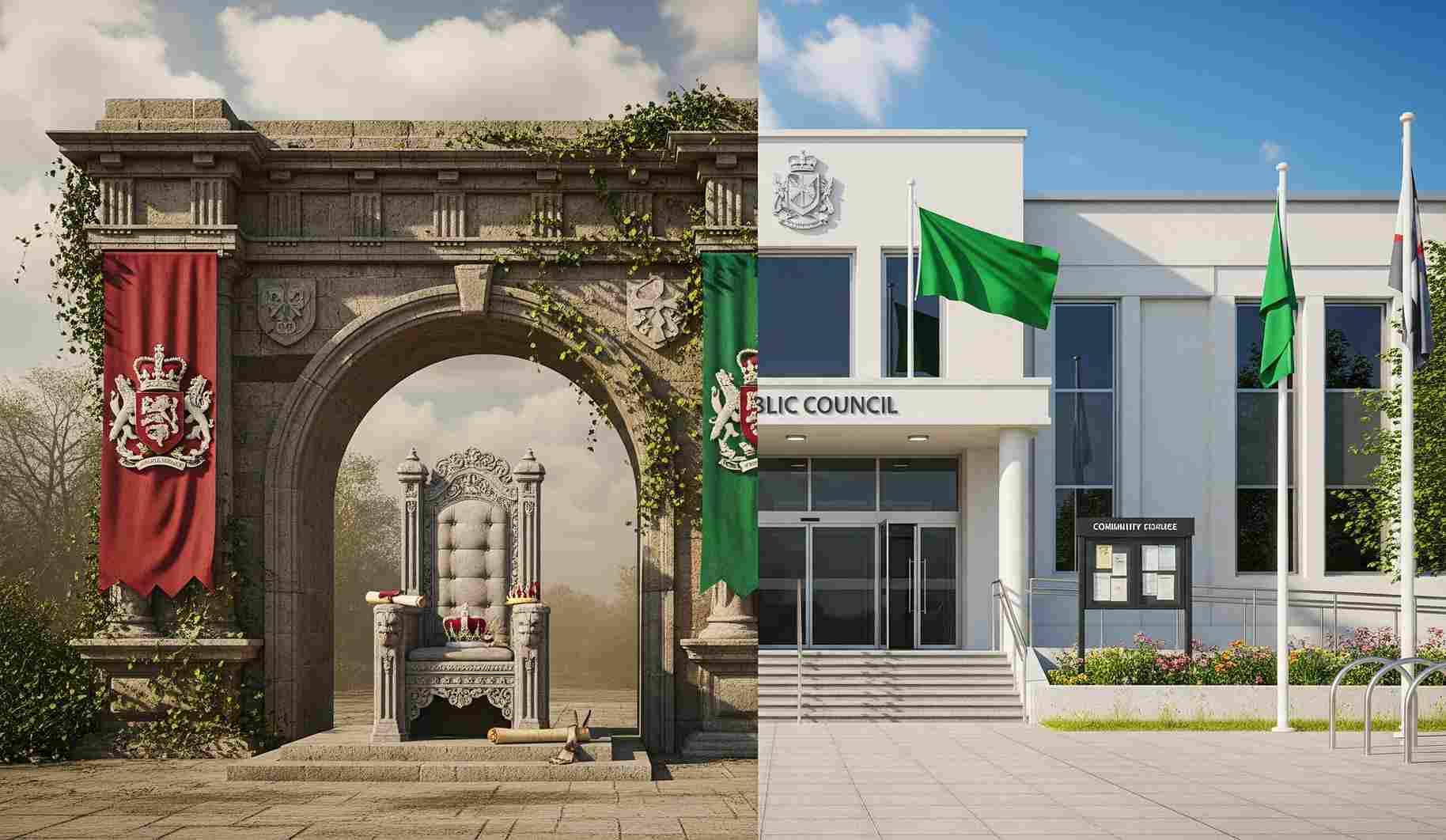
Hey friends! Ever wonder what your country’s government would be like if it wasn’t led by a king or queen? We hear the term monarchical, and we think kings, queens, monarchs: those royal rulers of territories who rule by way of heredity. But let me ask you, what’s the antonym of monarchy? So what are the true choices if you don’t have a royal family running the country?
And today we’re going to dive deep in the muck of that, discussing the various types of government that oppose monarchy. Even more, we’ll elaborate a bit from the basic definition and help you understand it fairly well, at least with some examples we’re living in! So, let’s get started!
What Does “Opposite of Monarchical” Mean?
First of all, let’s identify what we’re discussing. Monarchical is the term used to describe a government in which a monarchy heads that government. The antonym, in other words, has political systems in which a single royal person resides with unopposed control and hereditary right instead.
The reciprocal situation would then be a government that:
Is not a dynasty system of government
Are democratic ranging leaders elected them are known to be voted into power
Shares authority with other people or groups
Now let me help you understand some big categories of government, which are opposite to the kind of systems a monarchy is.
Key Alternatives to Monarchy
Let’s explore the most common and significant alternatives.
1. Republic
Definition:
In political terms, a republic is a How indeed? “Power belongs to the people or their representatives.
Key Features:
Elected Presidents or Leaders
No heredity rule
Citizens have voting rights
Leaders serve fixed terms
Example:
Except that we are not governed by a king; we are citizens of the world’s oldest and most successful republic, a fact easily forgotten in an era where leadership is everywhere else up to its neck in despotism or dictatorship. The United States, France, India — all republics.
2. Democracy (Direct & Representative)
Definition:
Democracy is a system where the power ultimately resides with the people. It can be direct (people vote on laws themselves) or indirect (through elected representatives).
Key Features:
- Free, fair elections
- Equal voting rights
- Absence of hereditary monarchy
Example:
Switzerland practices direct democracy with referendums, whereas the UK uses a parliamentary democracy.
3. Oligarchy
Definition:
An oligarchy is a government ruled by a small group of powerful people, often wealthy or influential.
Key Features:
- Power concentrated among a few elites
- Not based on heredity but often economic or social status
- Can exist within republics or democracies
Example:
Historically, ancient Sparta had elements of oligarchy, and modern-day Russia has been described by some as oligarchic.
4. Anarchy
Definition:
Anarchy is a state of society without any government or formal leadership.
Key Features:
- No centralized authority
- Based on voluntary cooperation
- Generally unstable or temporary
Example:
Certain regions during civil conflicts or revolts — though not a sustainable or desirable long-term system.
Comparing the Systems: A Detailed Table
| Feature | Monarchy | Republic | Democracy | Oligarchy | Anarchy |
|---|---|---|---|---|---|
| Leadership Source | Hereditary (royal family) | Elected or appointed | Voting by citizens | Small ruling elite | No leadership |
| Power Concentration | Concentrated in monarch | Distributed among elected leaders | Power reflects the people’s choice | Concentrated in few elites | No centralized power |
| Stability | Usually stable, long-term | Stable, depends on governance | Varies; can be stable or chaotic | Often unstable or controlled | Unstable, unpredictable |
| Example Countries | UK, Saudi Arabia | USA, Germany | India, Australia | Russia (oligarchic elements) | Not typically institutionalized |
Why Is Understanding These Systems Important?
Knowing the opposite of monarchical systems helps us appreciate how countries govern themselves and choose leaders. It gives us a clearer picture of democracy’s importance, the dangers of unchecked power, and why some nations prefer one system over another.
Main Takeaway:
Different government types shape a country’s stability, rights, and freedoms. Recognizing whether a government is a monarchy or an alternative helps us understand their history and policies better.
Tips for Success in Understanding Government Systems
- Compare with real-world examples: This helps you grasp abstract concepts.
- Use visual aids: Charts, tables, or diagrams make complex info easier.
- Stay updated: Political systems evolve; staying current helps in understanding current governments.
- Practice active learning: Write summaries, ask questions, or discuss with peers.
Common Mistakes and How to Avoid Them
Mistaking oligarchy for monarchy: Keep in mind, an oligarchy is the governing of a country by a few people and not by the right of descent.
If all democracies are the same: There’s a big difference — direct vs. representative.
Assuming anarchy is chaos: Although they are related ideas, some societies can structure themselves without the need of a central authority.
Overgeneralizing examples: Every government in a country is different; context is key.
Variations and Hybrid Systems
Many countries today have mixed systems:
- Constitutional Monarchy: Royal family exists but has limited powers (e.g., UK, Japan)
- Parliamentary Republic: Elected leadership with a ceremonial monarch (e.g., Sweden)
- Authoritarian Regimes: Not monarchical but still undemocratic (e.g., North Korea)
Understanding these nuances broadens your grasp of global governance.
Why Does It Matter?
Knowing the opposites of monarchy isn’t just academic. It influences how citizens engage in politics, defend their rights, and participate in decision-making processes. Plus, understanding different government systems helps us appreciate democracy’s role in protecting freedom and equality.
Practice Exercises to Weld Your Knowledge
1. Fill-in-the-blank:
The system where leaders are chosen through voting and power is not hereditary is called a __________.
2. Error correction:
Choose the sentence with an error and correct it:
“The king or queen governs directly in a republic.”
3. Identification:
Identify whether the following is a monarchy, republic, or democracy:
The President is elected every four years by citizens.
4. Sentence construction:
Construct a sentence explaining why an oligarchy can be unstable.
5. Category matching:
Match each system to its characteristic:
- System where power resides with a few elites – ________
- No government, relies on voluntary cooperation – ________
- Leaders elected by citizens – ________
Final Words
You can’t grasp the inverse of monarchical systems without this, which is a must-read for anyone curious about how countries work. Republic or democracy, whatever the case these systems reflect distinct concepts of power, governance and citizen representation. I hope that this guide helped clear up any questions you had, and gave you some useful insights. Keep checking things out, and remain curious —- and remember: how countries are run affects us all!
Until then, keep pondering these interesting political systems — it doesn’t hurt to mull over freedom and knowledge!
